
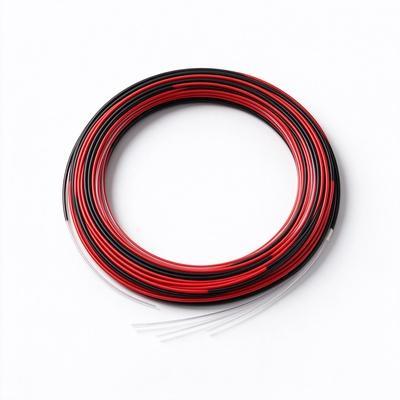
Blowing distance on an installable fibre cable is set by jacket friction, and jacket friction is set by the surface — which on an HDPE sheath means how well the 2.5% carbon black and any mineral filler have dispersed. Poor dispersion gives specks, weak UV protection and a rough skin that stops the cable short of the far end of the duct. Xiangxi DX755A — white pellet silicone masterbatch on a PE+ carrier at 1.5–2.5%, typically 2.0% — wets the carbon black and filler, drops extrusion torque, and gives the smooth low-friction sheath that longer blowing runs depend on.
Carbon black agglomerates — undispersed black gives surface specks, uneven UV protection and local stress points that fail the crush and impact tests.
Jacket friction limits blowing — the cable is pushed by compressed air; every extra tenth of coefficient of friction comes straight off the achievable duct length.
Filler-driven torque and die build-up — mineral-filled HDPE sheaths run hot and deposit at the die lip, which scores the sheath and raises the friction you were trying to reduce.
| Parameter | Typical window | What to watch |
|---|---|---|
| DX755A dosage | 1.5% → 2.0% → 2.5% | Stop when torque and friction stop improving |
| Carbon black | 2.0–2.6 wt% | Check dispersion rating to ISO 18553 |
| Mineral filler | 0–30 wt% | Above 30%, keep dosage at 2.5% |
| Melt temperature | 190–210 °C | HDPE needs the heat; watch oxidation |
| Surface friction | Lower on duct-wall simulation | Measure jacket-on-duct, not jacket-on-steel |
| Crush and impact | IEC 60794-1-2 E3 / E4 | Re-test on the finished cable |
| Product name | Appearance | Carrier resin | Recommended dosage (W/W) | Application scope |
|---|---|---|---|---|
| DX750 | White pellet | PE+ | 0.5–3% | PE, TPE |
| DX751B | White pellet | PE+ | 0.5–3% | PE, TPE |
| DX752B | White pellet | PE+ | 0.5–3% | PE, TPE |
| DX752A | White pellet | PE+ | 0.5–3% | PE, TPE |
| DX753A | White pellet | PE+ | 0.5–3% | PE, TPE |
| DX753 | White pellet | PE+ | 0.5–3% | PE, TPE |
| DX755A | White pellet | PE+ | 0.5–3% | PE, TPE |
| DX752C | White pellet | PE+ | 0.5–3% | PE, TPE |
DX755A is the filler-wetting grade and the correct first choice whenever the sheath carries carbon black plus mineral filler: dispersion, not melt lubrication, is the constraint. For a lightly filled MDPE sheath, DX751B at 1.0–2.0% gives the same surface result for less additive. Indoor TPE-jacketed fibre and drop cables are better matched by DX750, and where the sheath is a very thin-wall micro-cable construction, DX752C handles the shear better.
Add at the hopper as a dry blend with the HDPE sheath compound, or have the compounder let it down at 2.0%.
Start at 1.5%, then 2.0%, then 2.5%, and check carbon black dispersion (ISO 18553) as well as torque at each step.
Keep the melt temperature in the HDPE window — do not trade heat for output, since oxidation will roughen the surface you are trying to smooth.
Measure jacket friction against the actual duct material, not against steel, or you will not see the gain that matters.
Coefficient of friction: lower jacket-on-duct, measured with your own blowing rig or a duct simulation.
Carbon black dispersion: better ISO 18553 rating, with fewer specks on the sheath surface.
Torque and melt temperature: lower at the same output, with less die-lip deposit.
Mechanical: crush, impact and ESCR results to IEC 60794-1-2 unchanged or better.
Start at 2.0%. Sheaths with mineral filler above 20% usually need 2.0–2.5%; unfilled MDPE sheaths respond at 1.0–1.5% with DX751B.
It does not provide UV protection, but better carbon black dispersion usually improves it. Re-run your IEC 60794 UV and weathering sequence on the finished cable.
Yes, in the direction you want: lower jacket friction against the duct wall means longer blowing distances. Verify on your own rig with the actual duct type.
Not within the 1.5–2.5% window. Better dispersion tends to remove the weak points where crush failures start; re-test to IEC 60794-1-2 to confirm.
Yes, though DX750 is the closer match for a soft indoor TPE jacket and typically needs a lower dosage.
Yes. Xiangxi wire and cable grades are RoHS and REACH compliant, SGS tested, produced under ISO 9001, and shipped with a COA per batch.
Testing DX755A on your Fiber Optic Cable Sheath? Send us your recipe and target — we return the matched grade, TDS and a 1 kg sample within 3 working days.

Xiangxi New Material — A professional China manufacturer of Silicone Masterbatches and plastic additives. RoHS & REACH compliant options available.
Privacy Policy ·
AI Policy ·
Copyright ·
Sitemap
Copyright © 2016-2026 Xiangxi New Material Co., Ltd. All Rights Reserved.