
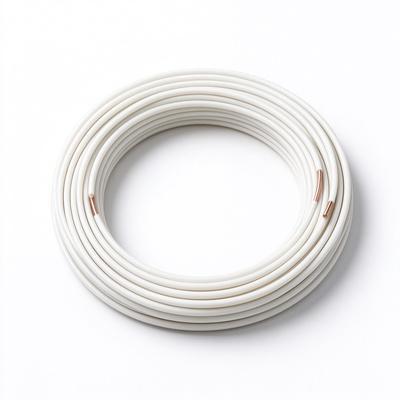
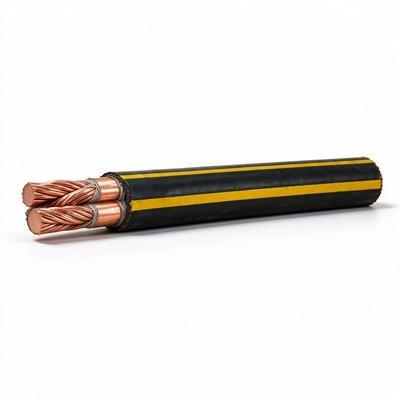
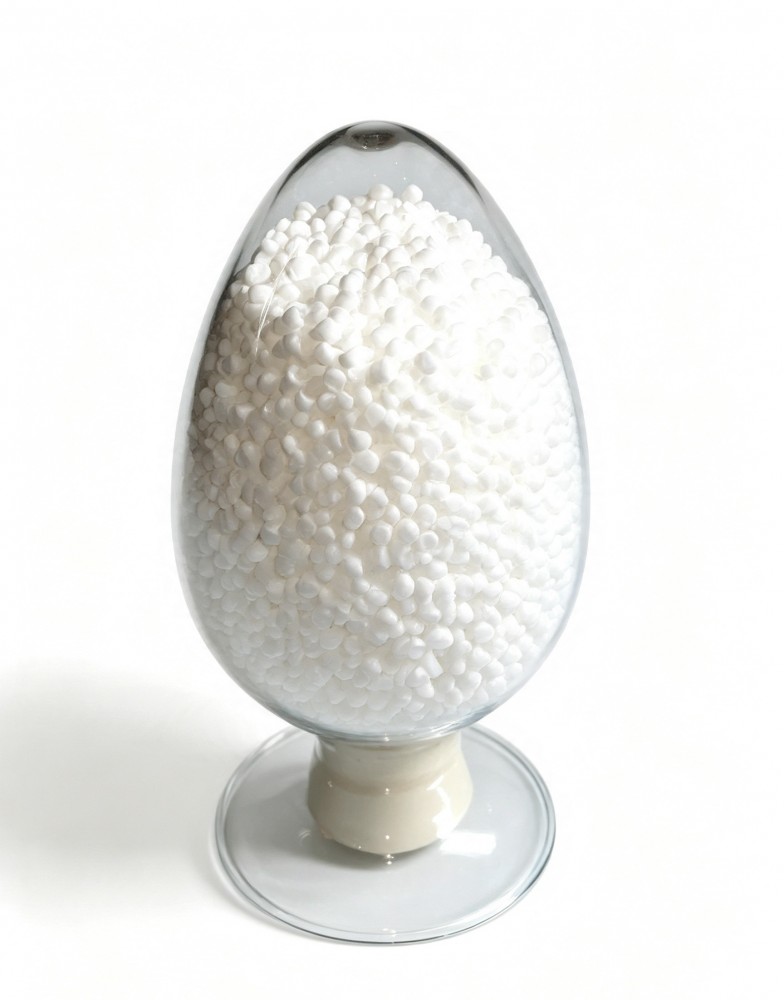
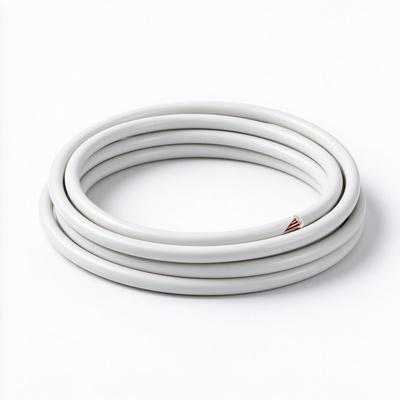
Every gram matters on an aircraft harness, so insulation walls keep getting thinner while the voltage and arc-tracking requirements stay put. That combination is brutal on the extruder: thin dies mean high shear, high shear means melt fracture, and melt fracture means a wall that will not hold capacitance or pass the dry arc-tracking test. Xiangxi DX752A — white pellet silicone masterbatch on a PE+ carrier at 0.5–1%, typically 0.8% — pushes the shear limit up, drops torque and head pressure, and holds the thin wall round and smooth enough for stable capacitance.
Shear-limited wall — below about 0.25 mm the melt reaches its slip-stick point at modest output, so the surface goes matte and the wall oscillates.
Surface protrusions at altitude — at reduced cabin pressure, any bump or void on the insulation is where partial discharge and tracking start.
Tight capacitance window — capacitance depends on wall thickness and concentricity; a rough, wobbling wall puts the value outside the AS22759 or EN 2083 limit.
| Parameter | Typical window | What to watch |
|---|---|---|
| DX752A dosage | 0.5% → 0.8% → 1.0% | Stop when capacitance spread stops tightening |
| Wall thickness | 0.15–0.35 mm | Below 0.15 mm, trial DX752C in parallel |
| Conductor preheat | Set and left fixed | Changing it ruins comparability |
| Melt temperature | At your qualified value | Do not trade temperature for speed |
| Capacitance spread | Inside AS22759 limit | Read the inline gauge, not a lab sample |
| Spark faults | Per drum, logged | Count start-up scrap separately |
| Product name | Appearance | Carrier resin | Recommended dosage (W/W) | Application scope |
|---|---|---|---|---|
| DX750 | White pellet | PE+ | 0.5–3% | PE, TPE |
| DX751B | White pellet | PE+ | 0.5–3% | PE, TPE |
| DX752B | White pellet | PE+ | 0.5–3% | PE, TPE |
| DX752A | White pellet | PE+ | 0.5–3% | PE, TPE |
| DX753A | White pellet | PE+ | 0.5–3% | PE, TPE |
| DX753 | White pellet | PE+ | 0.5–3% | PE, TPE |
| DX755A | White pellet | PE+ | 0.5–3% | PE, TPE |
| DX752C | White pellet | PE+ | 0.5–3% | PE, TPE |
DX752A is the high-shear option and the correct default for thin-wall aerospace insulation, because it works at the die land where melt fracture begins. Below roughly 0.15 mm wall, or on the fastest small-gauge lines, DX752C is the stronger version and worth trialling side by side. Where the insulation is crosslinked for a 200 °C rating, DX753A survives the crosslink step; for thicker walls above 0.5 mm, DX752B delivers the flow benefit at a lower dosage.
Meter with a loss-in-weight feeder at the throat rather than dry-blending, so dosage accuracy stays tight on small-gauge, high-value wire.
Start at 0.5% and step to 0.8% and 1.0%, running at least one full drum at each level before reading capacitance.
Hold conductor preheat, cooling length and line speed fixed across the trial; the only variable should be the masterbatch.
Save retention samples from every dosage step for arc-tracking and flammability testing, not just the final one.
Wall and capacitance: tighter spread on the inline gauge, with minimum wall thickness holding above the limit.
Surface: no shark-skin under raking light, uniform gloss along the drum.
Spark faults: fewer per drum, and shorter start-up scrap before the wire goes into tolerance.
Torque: lower at the same screw speed, or higher output at the same motor load.
Start at 0.8%. Walls between 0.15 and 0.25 mm usually settle at 0.8–1.0%; walls above 0.35 mm respond at 0.5%.
It does not change the polymer's tracking behaviour. Because the wall is smoother and more concentric, tracking results are usually more consistent; re-test to AS22759 or EN 2083 on your own wire.
The additive contributes no halogen and no measurable additional fuel. Smoke and toxicity must still be verified on the finished construction.
No. The grades are scoped for PE and TPE insulation; send us the construction and we will confirm whether a match exists.
No. The pellet is white and the carrier is natural, so the standard aerospace colour codes keep their shade and speck count drops.
Yes. Xiangxi wire and cable grades are RoHS and REACH compliant, SGS tested, manufactured under ISO 9001, and supplied with a COA per batch.
Testing DX752A on your Aircraft Wire Insulation? Send us your recipe and target — we return the matched grade, TDS and a 1 kg sample within 3 working days.

Xiangxi New Material — A professional China manufacturer of Silicone Masterbatches and plastic additives. RoHS & REACH compliant options available.
Privacy Policy ·
AI Policy ·
Copyright ·
Sitemap
Copyright © 2016-2026 Xiangxi New Material Co., Ltd. All Rights Reserved.