
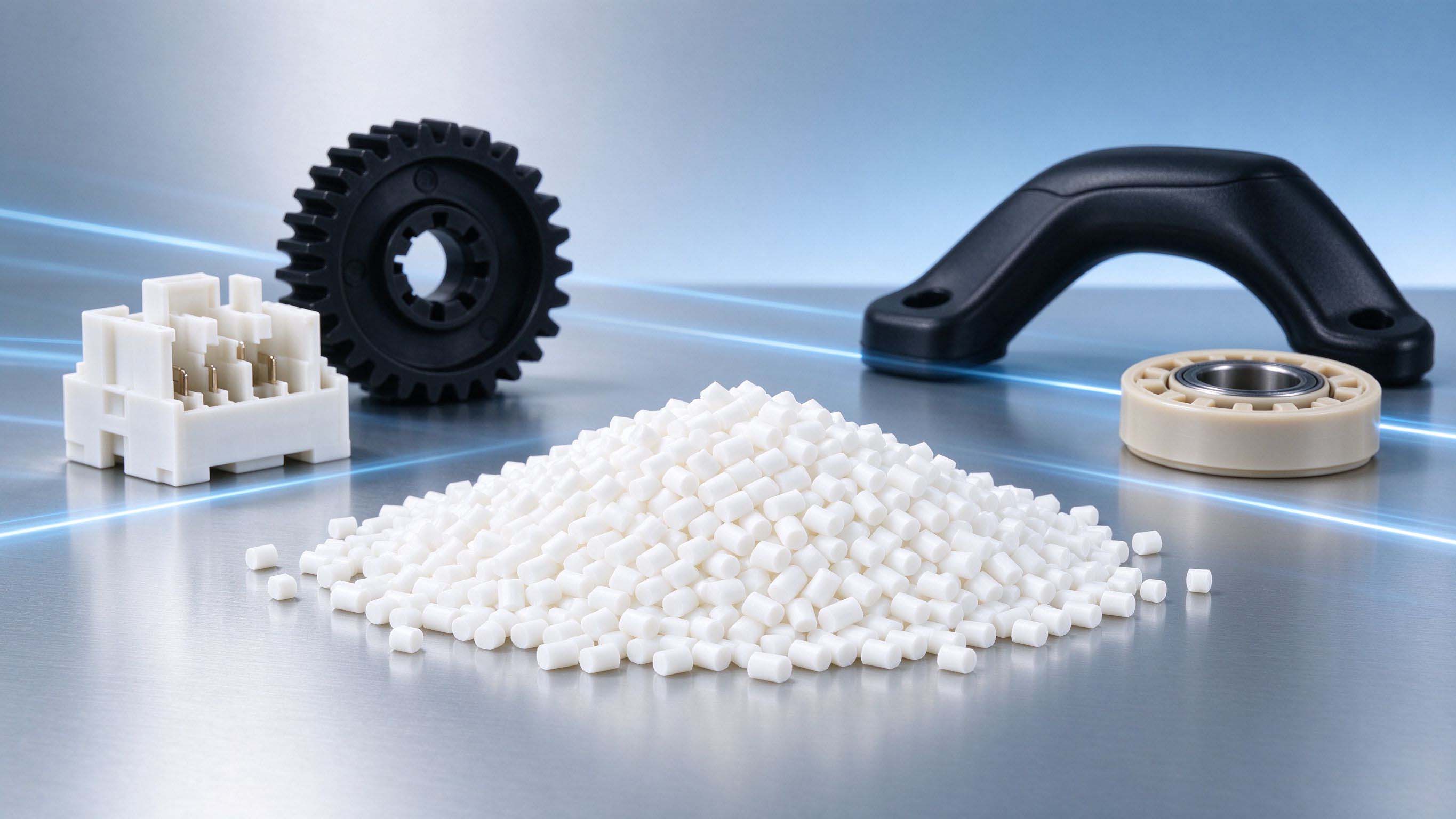
PA, PC, PBT and PET compounds demand more from additives: high processing temperatures, glass fiber loading and tight appearance specs. Floating fiber on a GF-PA50 part, high injection pressure on thin-wall connectors, or mold deposit on hot-runner tools — Xiangxi's engineering-plastics lubricants and carrier-free silicone series are built exactly for these high-temperature, high-performance systems.
The non-carrier silicone series is the flagship for PA, PC, PET and TPE systems: with no carrier resin, ultra-high molecular weight siloxane disperses directly into the matrix, wets glass fiber to eliminate floating fiber, improves flow and demolding, and remains stable with no precipitation across the part's life.
Our engineering-plastics lubricants act as external and internal lubricant in one: lower friction coefficient, higher pulling speed and low dosage — improving surface smoothness of PA/PBT/PET compounds while protecting screws and molds.
For alloy systems (PA/PP, PC/ABS) and filled compounds, the interfacial bonding alloy improves interphase compatibility, raising impact strength and surface quality of modified blends.
| System | Benefit |
|---|---|
| GF-PA6/PA66 (automotive, electrical) | No floating fiber, smoother surface, easier demolding |
| PC/ABS housings and connectors | Lower inner stress, improved flow, reduced warp and cracks |
| PBT/PET electrical parts | Stable processing at high temperature, less mold deposit |
| Polymer alloys and filled compounds | Better interphase bonding, higher impact strength |

With 28+ patents, 40% R&D personnel, ISO9001 production and 20,000+ tons/year capacity, Xiangxi develops high-temperature silicone systems specifically for engineering thermoplastics. Our carrier-free technology avoids carrier compatibility issues, and our lab supports MFI, friction and surface-appearance testing to prove performance on your compound before you scale.
A carrier can be incompatible with the base resin and dilute performance. Carrier-free siloxane disperses directly, giving stronger lubrication and fiber wetting at lower dosage with no compatibility risk.
Typically 0.5–2% depending on glass content and tool design. Most GF-PA30 systems see clear surface improvement at around 1%.
Yes. The ultra-high molecular weight siloxane is thermally stable at typical PA/PC/PBT processing temperatures without decomposition or discoloration.
Tell us your resin system and defect — contact Xiangxi and get a grade recommendation with test data.
Xiangxi New Material — A professional China manufacturer of Silicone Masterbatches and plastic additives. RoHS & REACH compliant options available.
Privacy Policy ·
AI Policy ·
Copyright ·
Sitemap
Copyright © 2016-2026 Xiangxi New Material Co., Ltd. All Rights Reserved.