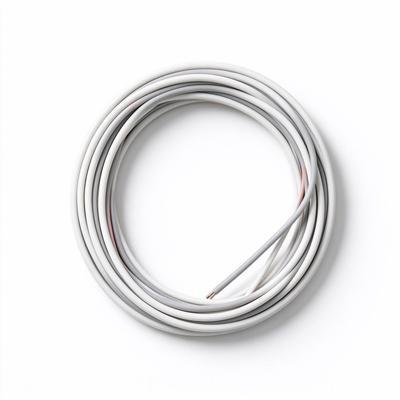

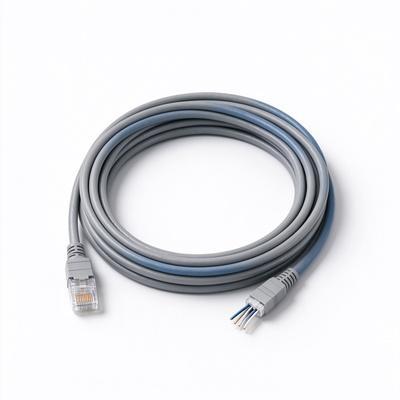
Lumps on a LAN cable jacket are almost never a polymer problem — they are die drool. Material creeps out of the die gap, oxidises on the hot lip, and periodically breaks off into the jacket, where it shows up as a bump that fails the diameter gauge and scuffs the installer's hand in the conduit. Xiangxi DX752A — white pellet silicone masterbatch on a PE+ carrier at 0.5–1.2%, usually 0.8% on a 0.5 mm jacket — clears the drool, drops torque, and gives the smooth low-friction skin that long conduit pulls need.
Die drool — low-viscosity fractions and additive residues separate out at the die exit, bake on the lip, and release as particles into the jacket.
Melt fracture at speed — jacketing lines run hard for capacity; past the critical shear rate the surface goes orange-peel and the jacket starts to shimmer.
High jacket friction — a rough skin raises pulling tension, which is what limits how many cables you can pull through one conduit.
| Route | Surface result | Trade-off |
|---|---|---|
| Manual die-lip wiping | Clean for a few minutes | Operator dependent, line stops |
| Reduce line speed 15% | Fewer defects | Direct capacity loss |
| Fluoropolymer processing aid | Smooth skin | Conditioning time, higher cost, fluorine content |
| Polish or re-chrome the die | Temporary improvement | Drool returns within a shift |
| DX752A at 0.8% | No drool, higher gloss | Works from the first kilogram |
| Product name | Appearance | Carrier resin | Recommended dosage (W/W) | Application scope |
|---|---|---|---|---|
| DX750 | White pellet | PE+ | 0.5–3% | PE, TPE |
| DX751B | White pellet | PE+ | 0.5–3% | PE, TPE |
| DX752B | White pellet | PE+ | 0.5–3% | PE, TPE |
| DX752A | White pellet | PE+ | 0.5–3% | PE, TPE |
| DX753A | White pellet | PE+ | 0.5–3% | PE, TPE |
| DX753 | White pellet | PE+ | 0.5–3% | PE, TPE |
| DX755A | White pellet | PE+ | 0.5–3% | PE, TPE |
| DX752C | White pellet | PE+ | 0.5–3% | PE, TPE |
DX752A is the high-speed jacketing grade: it acts at the die wall, which is where drool and melt fracture both start, and it does it at a low dosage that keeps the jacket cost per metre unchanged. Above roughly 800 m/min, or on small-diameter jacket where shear is highest, DX752C is the stronger option. For a halogen-free riser jacket with meaningful filler loading, use DX750 at 1.0–1.5%; plenum-rated jackets should be validated separately on your own compound.
Add as a hopper dry blend with the jacketing compound, or feed with a loss-in-weight feeder for tight control on a high-speed line.
Start at 0.5%, then 0.8%, then 1.2%. Judge each step by the diameter gauge and lump count, not by torque alone.
Give the line 15–20 minutes to stabilise after each dosage change before you take a verdict — drool builds and clears on a time constant, not instantly.
Keep the die-lip temperature zone unchanged during the trial so you are testing the masterbatch, not a thermal change.
Lump count: fewer diameter-gauge alarms per kilometre, verified against your ISO/IEC 11801 jacket OD tolerance.
Surface finish: higher and more consistent 60° gloss, no orange-peel under raking light.
Pulling friction: lower jacket-on-conduit friction, measured on your own pull rig or by ISO 8295.
Print quality: inkjet or hot-foil legend adhesion unchanged, checked with a tape test.
You should see the torque move within minutes, and the die lip will visibly stop accumulating within the first hour. Give the line one full shift before you judge the lump count, since deposits already on the lip have to work themselves out.
In most LAN jacketing recipes, no — DX752A replaces it and removes the conditioning period. Where a line is badly scorch-limited, run both and compare the lump count per kilometre.
No. The pellet is white and the carrier is natural-coloured, so coloured and striped jackets keep their shade; better pigment dispersion usually reduces specks.
It does not contribute flame retardancy or halogen. For CM, CMR or CMP ratings, re-test the finished cable to the relevant UL 444 or UL 910 procedure on your own compound.
Yes, if the insulation is PE-based. Thin-wall data insulation usually runs better on DX752C at 1.0–1.5%.
Yes. Xiangxi wire and cable lubricant grades are RoHS and REACH compliant, SGS tested, manufactured under ISO 9001, and sold with a COA per batch.
Testing DX752A on your LAN Cable Jacket? Send us your recipe and target — we return the matched grade, TDS and a 1 kg sample within 3 working days.
Xiangxi New Material — A professional China manufacturer of Silicone Masterbatches and plastic additives. RoHS & REACH compliant options available.
Privacy Policy ·
AI Policy ·
Copyright ·
Sitemap
Copyright © 2016-2026 Xiangxi New Material Co., Ltd. All Rights Reserved.