
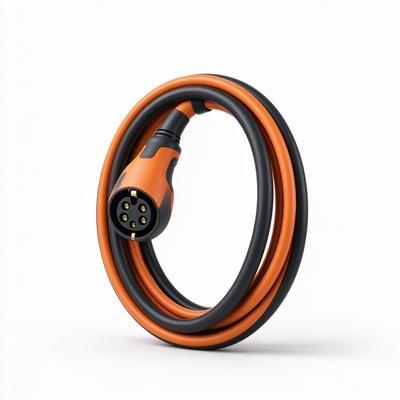
An EV charging cable gets dragged across concrete, coiled wet, and coiled again at −30 °C, and a plasticiser-free TPE sheath has to survive all of it without going stiff or tacky. Xiangxi DX753 — white pellet silicone masterbatch on a PE+ carrier at 1.5–2.5%, typically 2.0% on a 90 Shore A jacket — lowers the jacket coefficient of friction, cuts extrusion torque on high-filled halogen-free TPE, and leaves a surface that stays clean after handling. Cold bend to EN 50620 and oil resistance stay inside specification.
High jacket friction — a plasticiser-free TPE has a naturally higher coefficient of friction, so the cable drags, kinks on the drum and fights the user at every charge.
Filler-driven torque — halogen-free EV jackets carry 50–60% flame-retardant filler, which raises melt viscosity and forces the line to slow down or run hotter.
Dirt pick-up — a slightly tacky surface collects dust and road grime, and dark jackets show every mark on a showroom floor.
| Parameter | Typical window | What to watch |
|---|---|---|
| DX753 dosage | 1.5% → 2.0% → 2.5% | Stop when friction stops falling |
| Jacket hardness | 85–95 Shore A | Softer grades need the higher dosage |
| FR filler loading | 45–60 wt% | Above 55%, consider DX755A instead |
| Melt temperature | 160–180 °C | Keep below the MDH decomposition point |
| Surface friction | Target COF below 0.4 | Measure ISO 8295 on finished jacket |
| Cold bend | −30 °C, EN 50620 | Confirm no cracking after the trial |
| Product name | Appearance | Carrier resin | Recommended dosage (W/W) | Application scope |
|---|---|---|---|---|
| DX750 | White pellet | PE+ | 0.5–3% | PE, TPE |
| DX751B | White pellet | PE+ | 0.5–3% | PE, TPE |
| DX752B | White pellet | PE+ | 0.5–3% | PE, TPE |
| DX752A | White pellet | PE+ | 0.5–3% | PE, TPE |
| DX753A | White pellet | PE+ | 0.5–3% | PE, TPE |
| DX753 | White pellet | PE+ | 0.5–3% | PE, TPE |
| DX755A | White pellet | PE+ | 0.5–3% | PE, TPE |
| DX752C | White pellet | PE+ | 0.5–3% | PE, TPE |
DX753 is the match for flexible TPE jackets: it delivers the surface slip and low-temperature feel that a charging cable needs, and it does it without a plasticiser that can migrate. If the jacket compound is heavily halogen-free filled above about 55%, move to DX755A, which is built to wet that filler level. For a PE-based rather than TPE jacket, DX752B gives the flow benefit with a closer carrier match. Signal and control cores inside the same cable, being thin-walled, run better on DX752C.
Dry-blend with the TPE granules at the hopper. The pellet needs no drying, but dry the TPE itself if your supplier requires it.
Start at 1.5%, then 2.0%, then 2.5%. Log motor load and melt temperature at each step and pull jacket samples for friction testing.
Run the cold bend and oil-resistance checks on jacket from the highest dosage you intend to use, not on a lab plaque.
Side benefits to log: cleaner release from the capstan, less marking during coiling, and shorter start-up scrap at each shift change.
Coefficient of friction: lower on ISO 8295 or ASTM D1894, measured jacket-on-jacket and jacket-on-steel.
Extrusion torque: lower at the same output, or a higher output at the same motor load.
Abrasion: less mass loss on ISO 4649 or a jacket-on-concrete drag rig.
Cold bend and oil resistance: still passing EN 50620 and the relevant IEC 60811 oil immersion after ageing.
The friction drop is moderate and internal, not a surface coating, so the connector grip and the inkjet print still work. Run a tape test on your print and a pull-out check on the connector assembly before release.
Start at 2.0%. Softer compounds below 85 Shore A often need 2.5%; harder PE-based jackets need only 1.0–1.5%.
No. It is a process and surface aid used alongside your existing package, and it does not migrate the way a low-molecular-weight slip agent does, so the effect does not fade in storage.
Yes within the 1.5–2.5% window. Bond strength stays inside normal variation; no surface pre-treatment is needed if you mould within 24 hours of extrusion.
No. Confirm LOI and smoke density on your own jacket, but the masterbatch does not contribute halogen or change the FR system.
Yes. Xiangxi wire and cable grades are RoHS and REACH compliant, SGS tested, produced under ISO 9001, and shipped with a COA on every batch.
Testing DX753 on your EV Charging Cable Sheath? Send us your recipe and target — we return the matched grade, TDS and a 1 kg sample within 3 working days.

Xiangxi New Material — A professional China manufacturer of Silicone Masterbatches and plastic additives. RoHS & REACH compliant options available.
Privacy Policy ·
AI Policy ·
Copyright ·
Sitemap
Copyright © 2016-2026 Xiangxi New Material Co., Ltd. All Rights Reserved.