
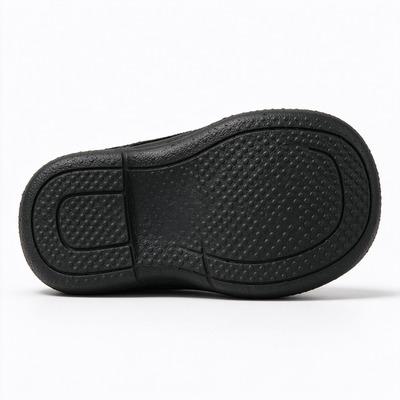
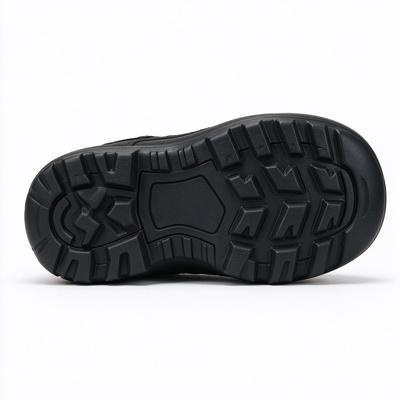
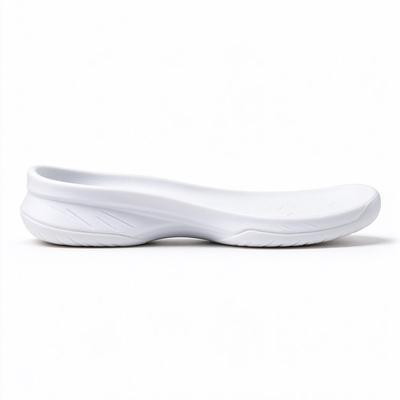
Ever notice that a recycled rubber outsole loses small pieces of crumb rather than wearing evenly — the particles simply tear out of the fresh compound. Xiangxi's DX052P anti-abrasion masterbatch, dispersed on an EVA+ carrier at 3–8%, closes that gap: it raises DIN abrasion resistance by roughly 30% on reclaim-loaded EVA/TPR outsoles, wets out the cured crumb so it stays bonded, and smooths the batch-to-batch swings that come with variable feedstock.
Crumb tears out, not wears off — devulcanised particles are already crosslinked, so without enough wetting they act as loose inclusions that pop out under shear and leave fresh pits behind.
Feedstock swings — recovered rubber varies in particle size, sulphur residue and black content, so each lot mixes differently and the abrasion spread between batches widens.
Boundary weakness at the edges — high reclaim loading leaves a filler-rich skin along the tread edge; that is where chunks break off on the first rough ground.
| Stage | Parameter | Target window |
|---|---|---|
| Internal mixer | DX052P added | With the crumb and filler charge, 4–6% |
| Reclaim loading | Devulcanised crumb | 30–50 phr without loss of tensile strength |
| Mixing | Dump temperature | 110–130 °C to avoid reclaim re-scorch |
| Moulding | Press cure | Unchanged T90; verify with ISO 6502 MDR |
| Verification | Abrasion method | ISO 4649 (DIN) plus ISO 20871 outsole test |
| Product name | Appearance | Carrier resin | Recommended dosage (W/W) | Application scope |
|---|---|---|---|---|
| N5015 | White pellet | EVA+ | 3–8% | EVA, TPR |
| DX051 | White pellet | EVA+ | 3–8% | EVA, TPR |
| DX052P | White pellet | EVA+ | 3–8% | EVA, TPR |
| DX053 | White pellet | EVA+ | 3–8% | EVA, TPR, TR, PVC |
| DX063 | White pellet | EVA+ | 3–8% | EVA, TPR — supercritical foaming |
| DX653A | White pellet | EVA | 3–8% | EVA, TPR |
DX052P — the working choice for reclaim-loaded EVA/TPR outsoles; it tolerates frequent black/colour changes and variable crumb lots.
DX653A — pick the pure EVA carrier version if the compound contains no TPR phase at all, typical on light-density sustainability lines.
DX053 — for mixed constructions where the outsole also carries TR or PVC inserts.
N5015 — the budget option for low-price soles where 30–40% reclaim already dominates cost.
DX063 — only when the regrind is being foamed in a supercritical process rather than press-cured.
Charge the white pellet together with the crumb so the siloxane reaches the reclaim surface early in the cycle; no pre-drying is required.
Start at 3% on virgin-heavy recipes and at 5% when reclaim exceeds 40%; most lines settle at 4–6%.
Hold dump temperature below 130 °C — the benefit comes from dispersion, not from extra mixing energy, and reclaim re-scorch costs more than it gains.
Track DIN loss per lot for the first six batches; a tightened spread is usually the first sign that crumb wetting has improved.
DIN abrasion loss (ISO 4649): about 30% lower at 4–6% against your current reclaim control.
Batch spread: markedly narrower volume-loss figures across different reclaim lots.
Edge integrity: fewer torn craters along the tread edge after rock or gravel contact.
Throughput: lower mixing torque and cleaner release from the mould without a higher reject rate.
Yes, roughly. Below 30% reclaim, 3–4% is normally enough; above 40% go to 5–6% because there is far more crumb surface that needs wetting.
No interaction has been seen in reclaim systems. Add it in the mixer rather than the reclaim drum, and check scorch time with an MDR on the first trial batch.
Yes. At 4–6% addition the recycled share of the compound changes by only a few points, and the paperwork for your recycled content claim is unaffected.
Run ISO 4649 (DIN) on both the control and the trial slab, add ISO 20871 when the finished outsole can be tested, and keep the same reclaim lot for both legs.
Hardness, rebound and wet slip stay within batch variation, so the change is confined to wear behaviour.
REACH and RoHS compliance statements, SGS test reports, ISO 9001 production, a TDS per grade and a COA with every batch.
Need DX052P data on your own recycled Rubber Outsole formula? Mail the base recipe and the abrasion figure you must hit; our lab matches the grade, issues the TDS and ships a 1 kg sample in 3 working days.

Xiangxi New Material — A professional China manufacturer of Silicone Masterbatches and plastic additives. RoHS & REACH compliant options available.
Privacy Policy ·
AI Policy ·
Copyright ·
Sitemap
Copyright © 2016-2026 Xiangxi New Material Co., Ltd. All Rights Reserved.