

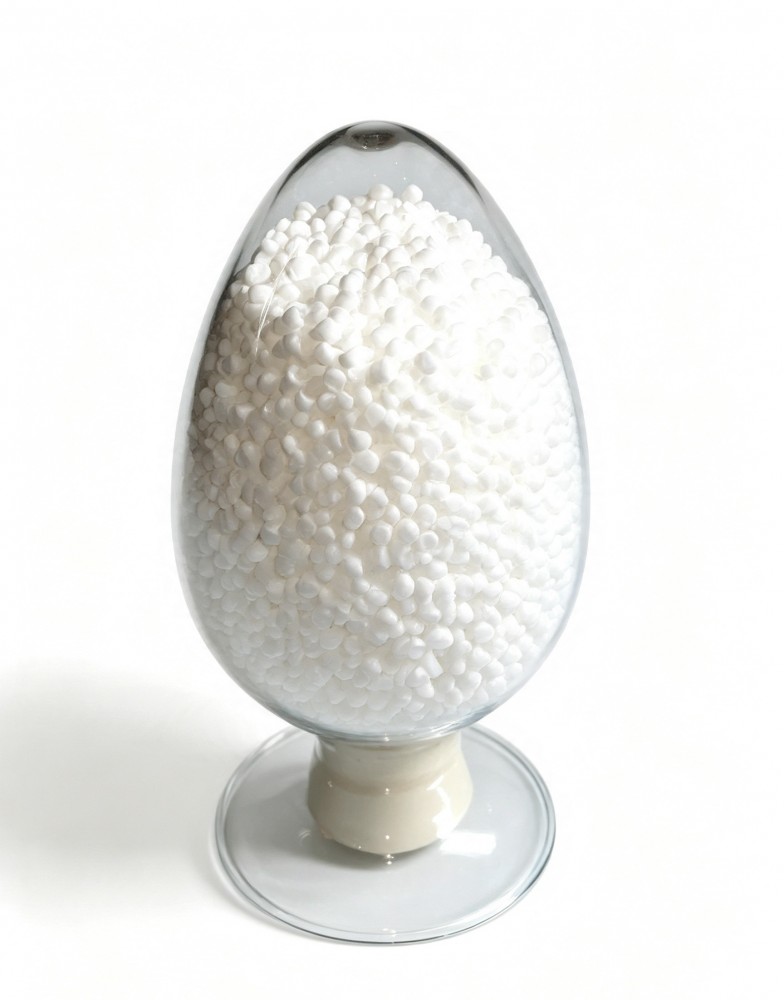
An office chair shell takes its abuse from clothing hardware. Rivets, belt buckles and zippers drag across the front edge several hundred times a week, and a filled PP shell that passes every structural requirement can look permanently marked within a few months. Dosing DX853C at 1.5–3% raises the critical scratch load of these filled shells and reduces the whitening that turns every contact into a permanent record of a single morning in the office.
Metal-on-polymer contact — a steel rivet concentrates load into a tiny contact area, so the local stress easily exceeds the debonding stress at the filler interface and leaves a white line.
Flex-assisted damage — the shell is designed to flex for comfort, so a scratch made while the part is loaded opens into a micro-crack rather than closing back up.
Surface chalking — shells near windows see UV and temperature swings; a stabiliser-depleted, micro-cracked skin loses its ability to recover and every mark stays visible.
| Route | Result | Trade-off |
|---|---|---|
| Lower filler loading | Less whitening | Loses shell stiffness, needs thicker wall |
| Co-extruded or two-shot skin | Soft skin hides marks | Capital cost, delamination risk |
| Upholstered cover | Marks hidden entirely | Material and assembly cost rises |
| Higher rubber content | Some gain | Inadequate creep behaviour, weak structure |
| DX853C in the existing shell compound | Higher critical load, less whitening | None inside the recommended amount range |
All three grades are metered into polypropylene and PP/TPE systems inside the same 0.5–5% band; they differ in the part geometry and filler system each one is matched to.
| Product name | Appearance | Carrier resin | Recommended dosage (W/W) | Application scope |
|---|---|---|---|---|
| DX853C | White pellet | PP+ | 0.5–5% | PP, TPE |
| DX8502A | White pellet | PP+ | 0.5–5% | PP, TPE |
| DX852 | White pellet | PP+ | 0.5–5% | PP, TPE |
DX853C — the correct starting point for a talc-filled shell with a defined mar requirement; use 1.5–3% depending on filler level.
DX8502A — for unfilled shells and any PP/TPE comfort strips or armrest paddings in the same assembly.
DX852 — the right alternative when the design reduces the wall to keep weight down and needs maximum flow length.
Introduce the pellet at the throat with the filled compound; no drying beyond the requirement of your base resin.
Start at 1.5% and go up in 0.5% steps; heavily filled shells generally need the upper half of the band.
Test the shell loaded, not flat, because flex-assisted scoring is the dominant failure here.
Combine the trial with your existing UV stabiliser check, since the two changes should be validated together.
ISO 19252 critical load — improved, and importantly not reduced after UV exposure.
Rivet-scratch rating — less whitening using a repeatable weighted scratch fixture.
Flex after scratch — shells loaded to their normal deflection should not open the mark further.
Gloss uniformity — steadier over the large contoured surface.
Flexibility comes from the base resin and wall geometry, not from this additive. Check backrest deflection against your ergonomic requirement after the trial.
It prevents damage rather than repairing it. The production benefit usually shows as fewer rejects caused by handling between moulding and final assembly.
Yes, though glass fibre breakage and floating fibre become the dominant surface issue, in which case the high-flow grade DX852 is often paired in the evaluation.
Usually 2–3% for 15–25% mineral-loaded compounds. Lighter loadings respond at about 1.5%.
Compatibility is usually fine, but FR packages are sensitive; re-run the relevant flammability requirement such as UL 94 or EN 1021 on the final compound.
ISO 9001 controlled batches with certificate of analysis, plus REACH and RoHS statements backed by SGS reports.
Testing DX853C on your Office Chair Shell? Send us your recipe and target — we return the matched grade, TDS and a 1 kg sample within 3 working days.

Xiangxi New Material — A professional China manufacturer of Silicone Masterbatches and plastic additives. RoHS & REACH compliant options available.
Privacy Policy ·
AI Policy ·
Copyright ·
Sitemap
Copyright © 2016-2026 Xiangxi New Material Co., Ltd. All Rights Reserved.