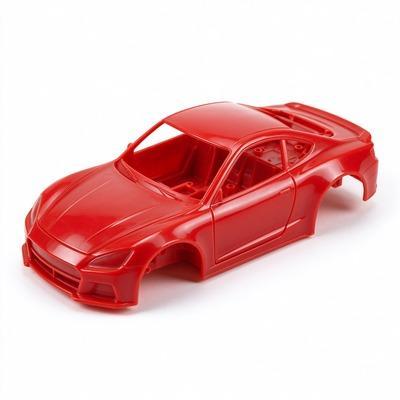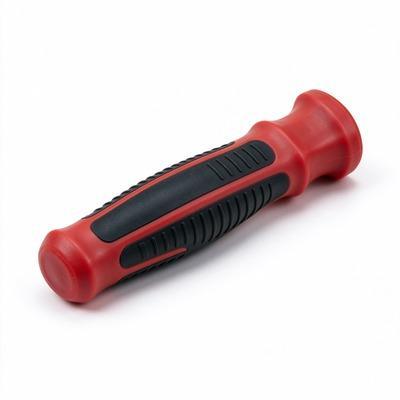

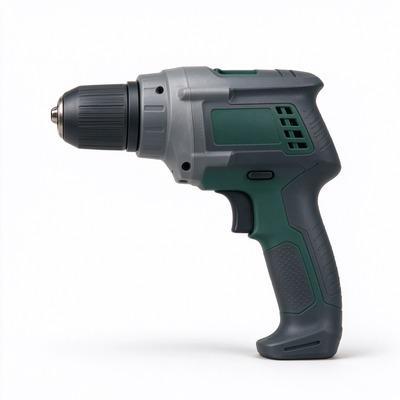
A cordless drill housing is a structural component. It carries the motor reaction torque, uses thin highly ribbed walls to keep weight down, and is squeezed by a hand — often gloved — at every use, then set down on rough surfaces. Damage accumulates fastest exactly where the shell is thinnest. Running DX853C at 1.5–2.5% in the filled PP housing compound raises surface durability while the internal lubrication lowers the injection pressure those long, thin, highly ribbed walls demand.
| Parameter | Without lubrication | With DX853C 1.5–2.5% |
|---|---|---|
| Peak injection pressure | At machine limit | Clear margin |
| Melt temperature for the rib network | High | Lower, less degradation risk |
| Release from deep grip ribs | Grabbing, marks on the visible surface | Cleaner release |
| Scuff appearance after site simulation | Heavy localised marking | Lighter, more even |
| Motor load during plasticising | High | Reduced |
All three grades are metered into polypropylene and PP/TPE systems inside the same 0.5–5% band; they differ in the part geometry and filler system each one is matched to.
| Product name | Appearance | Carrier resin | Recommended dosage (W/W) | Application scope |
|---|---|---|---|---|
| DX853C | White pellet | PP+ | 0.5–5% | PP, TPE |
| DX8502A | White pellet | PP+ | 0.5–5% | PP, TPE |
| DX852 | White pellet | PP+ | 0.5–5% | PP, TPE |
Impact is set by the base resin and reinforcement; nothing here replaces them. Verify ISO 179 Charpy and your own drop specification on the finished tool.
Friction is reduced slightly, but most tools specify textured or overmoulded grip areas precisely because feel matters, so those should be evaluated as moulded.
Yes. With glass the bigger visible win is usually less fibre float, so it is worth comparing DX852 in parallel on those variants.
The change itself does not add conductivity or combustibility, but any compound change on a power tool should be re-verified against UL 94 and the relevant insulation requirements.
Begin at 1.5%, and only reach 2.5% if pressure and appearance have not yet levelled off. Few programmes benefit beyond that point.
ISO 9001 production control with a batch certificate of analysis, plus REACH and RoHS documentation supported by SGS reports.
Testing DX853C on your Power Drill Housing Grip? Send us your recipe and target — we return the matched grade, TDS and a 1 kg sample within 3 working days.
Xiangxi New Material — A professional China manufacturer of Silicone Masterbatches and plastic additives. RoHS & REACH compliant options available.
Privacy Policy ·
AI Policy ·
Copyright ·
Sitemap
Copyright © 2016-2026 Xiangxi New Material Co., Ltd. All Rights Reserved.